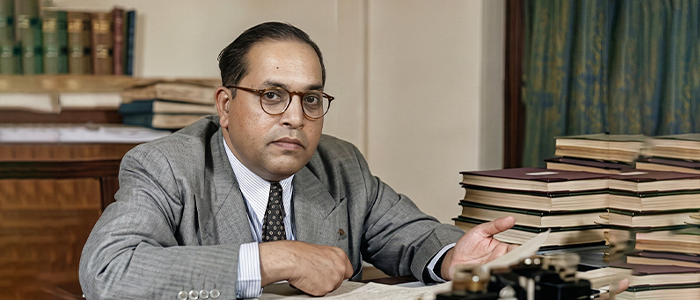
Dr. B. R. Ambedkar remains one of the most influential figures in Indian history, not only because he was the chief architect of the Indian Constitution, but because he fundamentally reshaped the idea of equality, justice, and education in India. His life is not just a historical narrative—it is a living inspiration for millions who believe that circumstances do not define destiny. His journey from a marginalized background to becoming one of the most educated and respected leaders of India stands as one of the strongest examples of how education can transform lives.
Born on April 14, 1891, in Mhow (present-day Madhya Pradesh), Ambedkar faced intense social discrimination from a very young age. Belonging to a Dalit family, he experienced exclusion in school, denial of basic rights, and systemic inequality that was deeply rooted in society. Yet, what set him apart was his refusal to accept these limitations as permanent. He chose education as his weapon, a tool that would not only uplift him personally but also empower millions who were oppressed.
Ambedkar’s academic journey was extraordinary. He pursued higher education at prestigious institutions like Columbia University in the United States and the London School of Economics. At a time when education itself was inaccessible to many in India, especially from marginalized communities, Ambedkar not only accessed it but excelled at the highest levels. His deep understanding of economics, law, politics, and social structures gave him the intellectual strength to challenge the injustices of his time.
One of the most defining aspects of Ambedkar’s life was his belief that education is the foundation of freedom. He strongly advocated that social reform and equality cannot be achieved without knowledge. According to him, education was not merely about literacy or degrees; it was about awareness, self-respect, and empowerment. He encouraged people to “educate, agitate, and organize,” a philosophy that continues to guide social movements even today.
As the chairman of the drafting committee of the Indian Constitution, Ambedkar ensured that the principles of equality, justice, and fundamental rights were deeply embedded in the nation’s legal framework. The Constitution of India stands as a powerful document that guarantees rights to all citizens, irrespective of caste, religion, or gender. His vision was clear—India should be a country where every individual gets equal opportunities to grow and succeed.
However, Ambedkar’s contribution was not limited to law and politics. He was also a social reformer who worked tirelessly to eradicate caste-based discrimination. He fought for the rights of women, laborers, and marginalized communities. He believed that true democracy is not just about political power but about social and economic equality. His reforms laid the groundwork for a more inclusive and progressive society.
In today’s context, Ambedkar’s vision is more relevant than ever. While India has progressed in many ways, challenges like educational inequality, lack of awareness, and career confusion still exist, especially in smaller towns and rural areas. Many students are forced to drop out due to financial issues, lack of guidance, or societal pressure. This is where institutions like S.K. Bright Institute play a crucial role.
S.K. Bright Institute is not just an educational center; it is a platform that carries forward Ambedkar’s philosophy of education as empowerment. Located in Mothabari, Malda, the institute focuses on guiding students who are often confused, disconnected, or have discontinued their education. It provides them with a second chance—a chance to restart, rebuild, and redefine their future.
What makes S.K. Bright Institute aligned with Ambedkar’s vision is its commitment to accessibility and inclusivity. The institute offers multiple academic pathways, including undergraduate, postgraduate, and professional courses, ensuring that students from different backgrounds can find a suitable direction. Whether it is a student who has just completed school, a graduate seeking higher education, or someone who had to drop out earlier, the institute ensures that no one is left behind.
Ambedkar believed that education should not be a privilege but a right. In the same spirit, S.K. Bright Institute provides flexible learning options, including regular and distance education, making it easier for working individuals and financially constrained students to continue their studies. This approach reflects a deeper understanding of real-life challenges faced by students and offers practical solutions rather than theoretical promises.
Another significant aspect of Ambedkar’s philosophy was self-respect. He believed that education gives individuals the confidence to stand up for themselves and make informed decisions. In modern times, career confusion is one of the biggest challenges among students. Many do not know which path to choose or how to build a stable future. Institutions like S.K. Bright Institute address this gap by providing career guidance, helping students choose courses that align with their interests, strengths, and market demand.
Ambedkar’s life also teaches us the importance of resilience. Despite facing countless obstacles, he never gave up. He transformed his struggles into strength and used his knowledge to bring change. This message is particularly important for today’s youth. Failure, setbacks, and delays are not the end—they are part of the journey. What matters is the willingness to continue and the courage to start again.
Education, as Ambedkar envisioned, is not limited to textbooks or classrooms. It is about understanding the world, questioning injustice, and building a better future. It is about breaking barriers and creating opportunities. When students choose to continue their education, they are not just improving their own lives—they are contributing to the progress of society.
Ambedkar Jayanti is not just a day of remembrance; it is a reminder of responsibility. It reminds us that the rights and opportunities we have today are the result of immense struggle and vision. It challenges us to use these opportunities wisely and to ensure that education reaches every corner of society.
For students in regions like Malda and nearby areas, institutions like S.K. Bright Institute act as a bridge between dreams and reality. They provide not just courses but direction, not just education but confidence. They embody the idea that it is never too late to learn and never too late to succeed.
In conclusion, Dr. B. R. Ambedkar’s legacy is not confined to history books. It lives in every student who chooses education over limitation, in every individual who stands up against inequality, and in every institution that works to make education accessible to all. His message is simple yet powerful—education is freedom. It has the power to change lives, transform societies, and build nations.
As we remember him, the most meaningful tribute we can offer is to follow his path—to learn, to grow, and to help others do the same. Institutions like S.K. Bright Institute continue this journey, ensuring that Ambedkar’s vision does not remain an idea but becomes a reality in the lives of countless students.
Education is not just a step forward. It is a revolution.