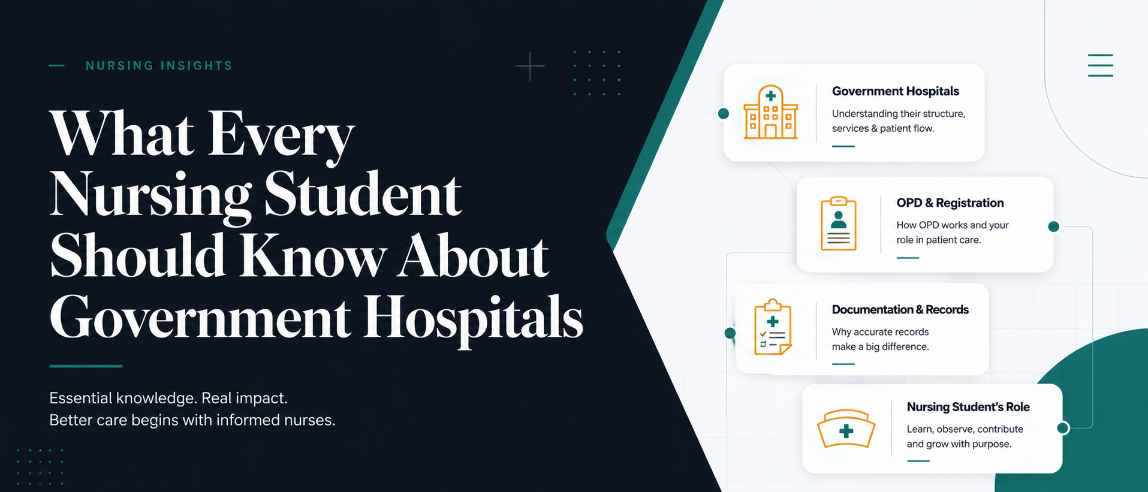
Government Hospitals in India: What Every Nursing Student Must Know Before Entering the Field
Choosing nursing or a paramedical course is one of the most consequential career decisions a student can make. S.K. Bright Institute helps students with admissions every year — but admission is only the beginning.
What happens after you enter the system? What kind of hospitals will you work in? How are they structured? Most students have never been inside a large government hospital before their first clinical rotation. That gap creates real anxiety — and avoidable confusion.
This post gives you a clear picture of how India's government hospitals actually function.
Why Government Hospitals Matter for Your Career
The majority of nursing and paramedical jobs in India — especially in the public sector — are in government hospitals. State health departments, ESIC, railways, armed forces, and central government institutions hire thousands of nurses, lab technicians, radiographers, and OT assistants every year.
Even if you eventually work in a private hospital, your clinical training will almost certainly happen in a government facility. Understanding its structure makes you more effective from day one.
How a Government Hospital Is Organised
Large government hospitals — whether a district hospital or a national institution like KGMU, AIIMS, or PGIMER — follow a layered structure:
| Division | What It Includes |
|---|---|
| OPD (Outpatient Department) | Specialist consultations, daily patient registration |
| IPD (Inpatient Department) | Admitted patients, ward nursing, surgical recovery |
| Emergency / Casualty | 24×7 trauma, triage, critical stabilisation |
| Diagnostic Services | Pathology, radiology, sonography, ECG |
| Operation Theatre | Elective and emergency surgeries |
| ICU / HDU | Critical care nursing, ventilator management |
As a nurse or paramedical professional, you will rotate through most of these divisions during training and posting.
Understanding OPD — Your First Clinical Environment
OPD is where most patients first interact with the hospital system. Each department — Cardiology, Orthopaedics, Gynaecology, Neurology, Paediatrics — runs its own OPD on fixed days and timings. Specialist doctors attend only on scheduled days, not daily.
For a nursing student, understanding OPD means:
- Learning patient flow from registration to consultation
- Assisting with vitals, documentation, and crowd management
- Understanding referral pathways between departments
This is foundational clinical exposure, and it happens in the first year of most B.Sc Nursing and GNM programmes.
Major Government Hospitals You Should Know
India's premier government hospitals are also the biggest employers. These institutions set the benchmark for clinical standards:
| Hospital | City | Known For |
|---|---|---|
| AIIMS Delhi | New Delhi | All specialties, flagship institution |
| PGIMER | Chandigarh | Neurology, Cardiology, Transplant |
| KGMU | Lucknow | Oldest medical university, North India |
| SGPGIMS | Lucknow | Super-speciality referral centre |
| NIMHANS | Bangalore | Neuroscience, Psychiatry |
| JIPMER | Puducherry | South India premier institute |
| Safdarjung Hospital | Delhi | Largest central govt hospital |
If you're preparing for government nursing exams (AIIMS nursing officer, ESIC, NHM), knowing these institutions and their departmental structure helps you answer clinical scenario questions accurately.
A Practical Resource: SearchDoc.in
One problem students face before clinical rotations or job postings is finding accurate, current information about hospital departments, OPD schedules, and specialist availability. Official hospital websites are often outdated or difficult to navigate.
SearchDoc.in is a free health information portal that publishes verified, department-wise doctor lists and OPD schedules for major government hospitals across India — sourced directly from official public records. It currently covers hospitals in Delhi, Lucknow, Chandigarh, Bangalore, Puducherry, and West Bengal, with more being added.
For nursing students doing pre-placement research, or anyone visiting a government hospital for clinical observation, it's a genuinely useful reference.
Nursing Courses S.K. Bright Institute Can Help With
If you're considering a nursing or paramedical career and need guidance on which course fits your academic background and goals, S.K. Bright Institute provides direct admission support for:
- GNM (General Nursing and Midwifery)
- B.Sc Nursing
- ANM
- Paramedical and Allied Health Sciences courses
- B.Ed / D.El.Ed for those choosing the teaching track in health education
Our counselors are based in Malda and handle admissions to colleges across West Bengal and India. Call 74074 49697 or visit skbright.in to speak with a counselor.
Bottom Line
The hospital is not just where you work — it's where your entire training happens. The sooner you understand its structure, the more confident you'll be when you enter it. Government hospitals are complex, high-volume environments. Knowing how OPD, IPD, and emergency divisions work before your first rotation puts you ahead.